
Moving a fitness facility sounds simple until the first treadmill refuses to fit through the doorway. Suddenly, a project that seemed straightforward becomes a complicated operation involving heavy machinery, delicate electronics, narrow hallways, and equipment that was never designed to be moved without proper preparation.
Gym equipment relocation is one of the most underestimated challenges facility owners face. Whether you are moving an entire commercial gym, renovating a condominium fitness center, upgrading a hotel exercise room, or simply rearranging machines within an existing space, small mistakes can quickly turn into expensive problems.
A commercial treadmill is not ordinary furniture. Strength machines contain tensioned cables, weight stacks, pulleys, and precisely aligned components. Premium cardio equipment may include sophisticated electronics, touchscreens, sensors, and specialized electrical requirements. Moving these machines incorrectly can damage components, create safety concerns, and leave equipment unusable long after the relocation is complete.
For facility managers throughout South Florida, understanding the risks before moving equipment can prevent unnecessary expenses and operational disruptions. Florida Fitness Solution provides professional fitness equipment moving, installation, and technical services for commercial facilities across Miami-Dade, Broward, and Palm Beach counties. Knowing when specialized assistance is needed can make an enormous difference in protecting your investment.
Gym Equipment Relocation Requires More Planning Than Most Owners Expect
One of the biggest mistakes facility owners make is assuming that gym equipment relocation involves little more than disconnecting machines, loading them onto a truck, and placing them in a new location.
Commercial fitness equipment is engineered to withstand repetitive exercise movements under controlled operating conditions. That does not mean every machine is designed to tolerate uncontrolled lifting, tilting, or transportation.
Consider a large commercial treadmill. Its running deck, motor, frame, incline mechanism, and electronic console must remain properly supported during handling. Incorrect lifting points or excessive twisting can place stress on parts that were never intended to bear that type of load.
Strength equipment creates different challenges. Weight stacks can shift, cables may lose their correct routing, and frames may need to be separated into smaller sections before transportation.
At The Florida Fitness Solution, equipment moving and installation services are part of the company’s established service offerings. Its technicians handle the movement, installation, assembly, calibration, and testing of fitness equipment, helping facilities avoid complications that can result from improper handling.
The key is understanding that relocation begins long before anyone picks up a machine.
Mistake One Is Moving Equipment Without Evaluating Its Condition
Imagine relocating twenty pieces of commercial fitness equipment only to discover that several machines are malfunctioning after installation.
Were those problems caused during transportation, or did the equipment already have developing issues?
Without documenting equipment condition before the move, it may be difficult to determine what happened.
Before relocation, facility managers should evaluate each machine’s operational condition. Cardio equipment should be checked for unusual sounds, console errors, belt movement, and visible mechanical wear. Strength equipment should be examined for cable deterioration, loose hardware, damaged pulleys, and unstable components.
Photographs, serial numbers, equipment identification, and maintenance records provide a useful record of the condition of each machine.
A professional assessment can also identify machines that should be repaired before moving and equipment that may no longer justify the cost of transportation.
Routine gym equipment inspections are especially valuable before a major relocation because they provide insight into equipment condition and potential service needs.
Moving a machine that already requires attention may simply transfer an existing problem into a new facility.
Mistake Two Is Assuming Every Machine Can Be Moved Fully Assembled
A common assumption is that keeping equipment assembled will save time and money.
Sometimes it does. In other situations, that decision creates unnecessary risk.
Commercial strength machines often have frames, weight stacks, cable systems, and adjustable components that make them difficult to maneuver through standard doorways or around tight corners.
Attempting to force a fully assembled machine through an opening can damage walls, doorframes, flooring, or the equipment itself.
Improperly tipping a weight machine can also create an unstable load. Components that remain secure during normal exercise may shift when the machine is moved into an unusual position.
Certain machines require partial disassembly, securing of moving components, or specific lifting procedures before relocation.
This is why manufacturer instructions matter.
Major fitness equipment manufacturers establish installation and handling requirements for their products. For example, Life Fitness explains the importance of trained professional equipment delivery and installation, particularly because fitness machines can be heavy and difficult to handle.
Facility owners should always refer to the applicable equipment manual rather than assuming that every treadmill, elliptical, or strength machine can be transported using the same method.
Mistake Three Is Underestimating the Weight and Size of Commercial Equipment
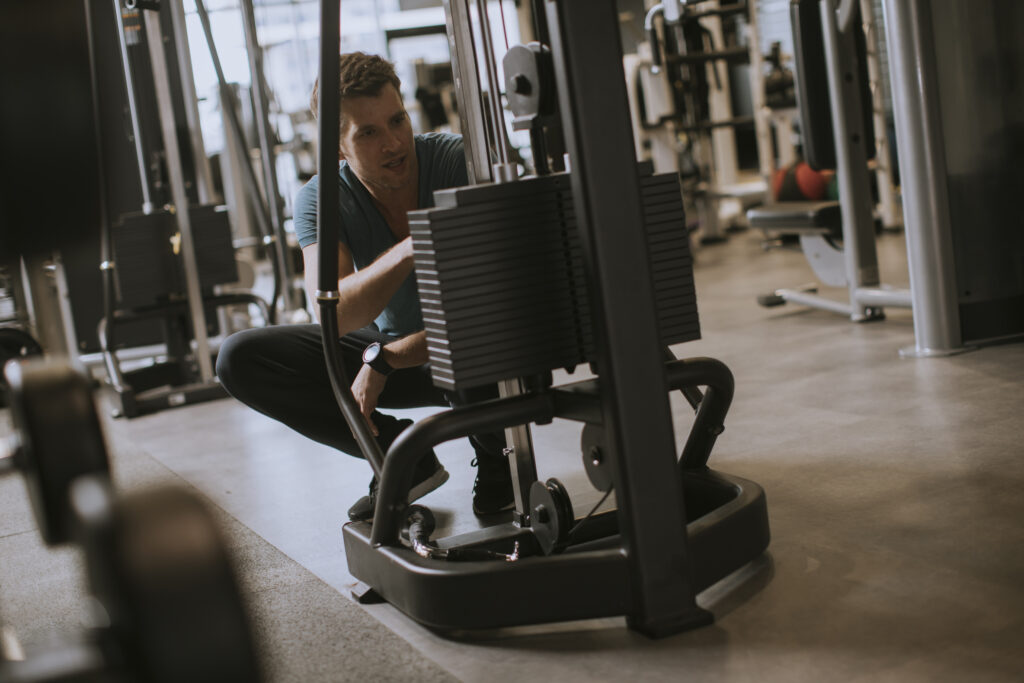
Commercial gym equipment can be considerably heavier and more awkward to handle than it appears.
Large treadmills, stair climbers, cable crossover systems, leg presses, and selectorized strength machines may require specialized transportation equipment and multiple trained personnel.
The challenge is not simply the total weight. It is also how that weight is distributed.
A machine with a high center of gravity can become unstable when tilted. An unusually shaped frame may be difficult to balance. Moving equipment over uneven surfaces or through narrow corridors adds further complications.
According to the Occupational Safety and Health Administration’s guidance on heavy lifting, handling bulky machinery without proper assistance or mechanical lifting equipment can increase the risk of workplace injuries. OSHA recommends appropriate material handling tools and careful planning when moving heavy loads.
For gym owners, this means assigning relocation work to employees without the proper experience can create risks that extend beyond damaged equipment.
A preventable injury, damaged building interior, or dropped machine can become far more expensive than arranging professional assistance from the beginning.
Mistake Four Is Forgetting to Measure the Entire Moving Route
Measuring the dimensions of the new fitness room is not enough.
Facility managers must also consider how equipment will reach that room.
A treadmill may fit perfectly in its intended location but be too wide to pass through the entrance. A commercial strength machine may fit inside an elevator but exceed its permitted load. A large piece of equipment may be difficult to maneuver around a narrow corner or through a stairwell.
Successful gym equipment relocation requires evaluating the entire transportation route.
This includes entrance dimensions, hallways, elevators, loading areas, staircases, ceiling heights, and potential obstacles.
In South Florida, these issues are particularly relevant for condominium towers, beachfront hotels, resorts, and commercial buildings with restricted service entrances.
Building management may also require advance coordination for elevator reservations, loading dock access, protective floor coverings, or approved moving hours.
Missing any one of these details can delay a project and lead to additional labor expenses.
Mistake Five Is Ignoring Flooring and Structural Requirements
A new fitness room may look ready for equipment, but appearance does not always tell the complete story.
Before installing heavy commercial machines, facility owners should consider the flooring surface, subfloor condition, equipment weight, and manufacturer placement requirements.
Uneven flooring can affect equipment stability and operation. Inadequate surface protection may allow heavy machines to damage finished floors during transportation. Some strength equipment also requires anchoring according to manufacturer specifications.
Moving a heavy machine across an unsuitable surface can leave scratches, dents, or other damage that may be expensive to repair.
For upper floor facilities, the building’s structural load capacity may also require review by a qualified professional, particularly when placing concentrated loads such as weight stacks or heavy strength equipment.
The Florida Fitness Solution offers fitness flooring products and installation solutions in addition to its equipment services. This makes flooring an important consideration when planning a renovation or relocating machines into a different environment.
Owners should evaluate the complete space before installation rather than discovering problems after the equipment has already arrived.
Mistake Six Is Overlooking Electrical Requirements
Modern commercial fitness equipment frequently depends on sophisticated electronic systems.
Treadmills, elliptical machines, stair climbers, and other cardio equipment may require specific electrical connections, dedicated circuits, grounding arrangements, or network connectivity.
A machine that operated perfectly in one facility may not function correctly when connected to an unsuitable power source in another.
Improper electrical arrangements can result in nuisance breaker trips, equipment errors, interruptions during operation, or damage to sensitive components.
Before relocating equipment, facility owners should review the electrical specifications provided by each manufacturer and have a qualified electrician evaluate the new location when necessary.
This is especially important when older fitness spaces are being converted into modern exercise facilities.
The fact that an outlet is available does not necessarily mean it is appropriate for the machine being installed.
Mistake Seven Is Failing to Protect Sensitive Components During Transportation
Commercial gym equipment contains more sensitive components than many people realize.
Touchscreen consoles, control boards, electronic sensors, wiring connections, and adjustable mechanisms may be vulnerable to vibration, impact, moisture, or improper handling.
Even when a machine shows no visible damage after transportation, internal problems can appear once it is powered on.
A loose connector may cause intermittent operation. A damaged sensor may create inaccurate readings. A shifted component can affect movement or generate unusual noise.
Proper preparation includes securing movable components, protecting vulnerable surfaces, organizing removed hardware, and using appropriate equipment handling methods.
For a full facility relocation, keeping a clear inventory of machines and their associated components is equally important.
A missing bracket, incorrect fastener, or misplaced accessory may delay reassembly even when the main equipment arrives without damage.
Mistake Eight Is Skipping Calibration and Testing After Installation
One of the most expensive assumptions facility owners can make is believing that a machine is ready for use simply because it has been reassembled and powered on.
Transportation can affect alignment, hardware connections, and component positioning. Any required adjustments should be completed before the equipment returns to regular service.
For treadmills, this may involve checking running belt tracking, tension, incline operation, and other functions according to the manufacturer’s procedures.
Strength machines may require verification of cable routing, weight stack movement, pulley operation, adjustment mechanisms, and frame stability.
Equipment that requires anchoring must be secured according to its installation instructions.
Testing should also confirm that safety features and controls operate properly.
This is an important distinction in The Florida Fitness Solution’s relocation services. The company states that its moving and installation work includes assembly, calibration, and operational testing after equipment is positioned.
A successful move is not complete when the last machine reaches the new room. It is complete when that machine has been properly installed and verified as ready for use.
Mistake Nine Is Failing to Consider Florida’s Environmental Conditions
South Florida adds another consideration that facility owners should not overlook.
Heat, humidity, coastal salt exposure, and sudden weather changes can complicate the movement and storage of exercise equipment.
Machines moved between climate controlled buildings, outdoor loading areas, storage locations, and transportation vehicles may encounter changing temperature and moisture conditions.
Electronic equipment should be protected from direct water exposure, while metal components and exposed surfaces should be handled with care in humid or coastal environments.
If equipment must be stored before installation, the storage environment should be evaluated rather than assuming an ordinary warehouse or temporary outdoor area is suitable.
These concerns are especially relevant for beachfront properties, resorts, residential towers, and facilities located near the coast.
A properly planned relocation considers not only the equipment and building, but also the conditions the machines will encounter along the way.
Mistake Ten Is Choosing a Moving Company Without Fitness Equipment Experience
A company that is excellent at moving office furniture may not have the technical experience required to relocate sophisticated commercial fitness equipment.
The distinction matters because fitness machines often require more than ordinary transportation.
Specialized equipment may need to be disassembled according to manufacturer instructions, moved using appropriate lifting procedures, reassembled with precise alignment, and tested before returning to use.
General movers may be able to transport a machine from one location to another, but facility owners should establish who will be responsible for mechanical preparation, final installation, calibration, and any problems discovered afterward.
Insurance coverage and responsibility for damage should also be confirmed before work begins.
The Florida Fitness Solution serves commercial gyms, hotels, condominium associations, resorts, wellness centers, rehabilitation facilities, and other fitness environments across South Florida.
Its combination of fitness equipment moving, installation, and repair expertise makes it relevant for facility managers looking to coordinate a relocation with the technical requirements of the equipment itself.
The Hidden Costs of Poor Gym Equipment Relocation
The initial moving expense is only one part of the financial picture.
A poorly planned relocation can create additional costs through equipment damage, replacement components, extra labor, delayed reopening, flooring repairs, and interrupted access to fitness amenities.
Consider a condominium fitness center undergoing a renovation. If equipment is moved without sufficient planning, a damaged machine may remain unavailable while replacement parts are ordered.
In a commercial gym, delayed installation can interfere with member access, personal training appointments, and planned reopening dates.
For a hotel or resort, unavailable fitness equipment may reduce the quality of the guest experience.
These consequences are difficult to predict precisely, but the cumulative expense can become significant. A relocation that initially appears inexpensive can ultimately cost thousands more when preventable complications occur.
That is why comparing moving quotes based solely on transportation costs can be misleading.
Facility owners should evaluate the complete scope of work, including preparation, protection, transportation, assembly, placement, testing, and responsibility for resolving problems.
When Is the Right Time to Plan a Gym Equipment Relocation?
The best time to plan a relocation is before construction, renovation, or moving schedules become fixed.
Facility owners should begin by determining which machines will remain in service, which may require repairs, and which equipment should be replaced rather than moved.
The next step is understanding the new facility’s layout and installation requirements.
Doorway measurements, access restrictions, electrical needs, flooring conditions, and scheduling limitations should all be considered before equipment is disconnected.
It is also worth reviewing service records. Moving an older machine that has experienced repeated failures may not be the best financial decision, particularly if its replacement was already being considered.
When technical planning becomes part of the relocation process early, facility owners have greater flexibility to manage costs and avoid unnecessary surprises.
Professional Equipment Moving Protects More Than Machinery
For a fitness facility, the real objective of relocation is not simply getting equipment from one building to another.
It is preserving the quality of the workout experience.
Members expect their preferred machines to feel familiar and perform correctly. Property managers want equipment available when residents return. Hotel operators want guests to find a complete, functional fitness center.
An equipment move that results in repeated breakdowns or extended downtime can undermine the purpose of the renovation itself.
Professional relocation planning helps protect equipment condition, support safe installation, and reduce disruption to daily facility operations.
It also gives managers a valuable opportunity to inspect their existing equipment, reconsider placement, address maintenance concerns, and improve the overall fitness environment.
Plan Your Next Move With Florida Fitness Solution
Whether you are relocating a single treadmill, reorganizing an existing fitness room, or preparing for a complete facility move, proper planning can help avoid expensive mistakes.
The Florida Fitness Solution offers equipment moving and installation services for fitness facilities throughout Miami Dade, Broward, and Palm Beach counties. Its experienced team handles equipment placement, assembly, calibration, and testing as part of the relocation process.
The company also provides ongoing equipment repair and technical support, helping facility owners maintain performance after installation.
If you are planning a fitness center renovation, equipment move, or facility expansion, contact Florida Fitness Solution to discuss your equipment and project requirements.
A successful relocation should leave your facility ready for members, not facing a new collection of equipment problems. Taking the time to plan correctly is one of the smartest ways to protect your investment and avoid unnecessary costs.
